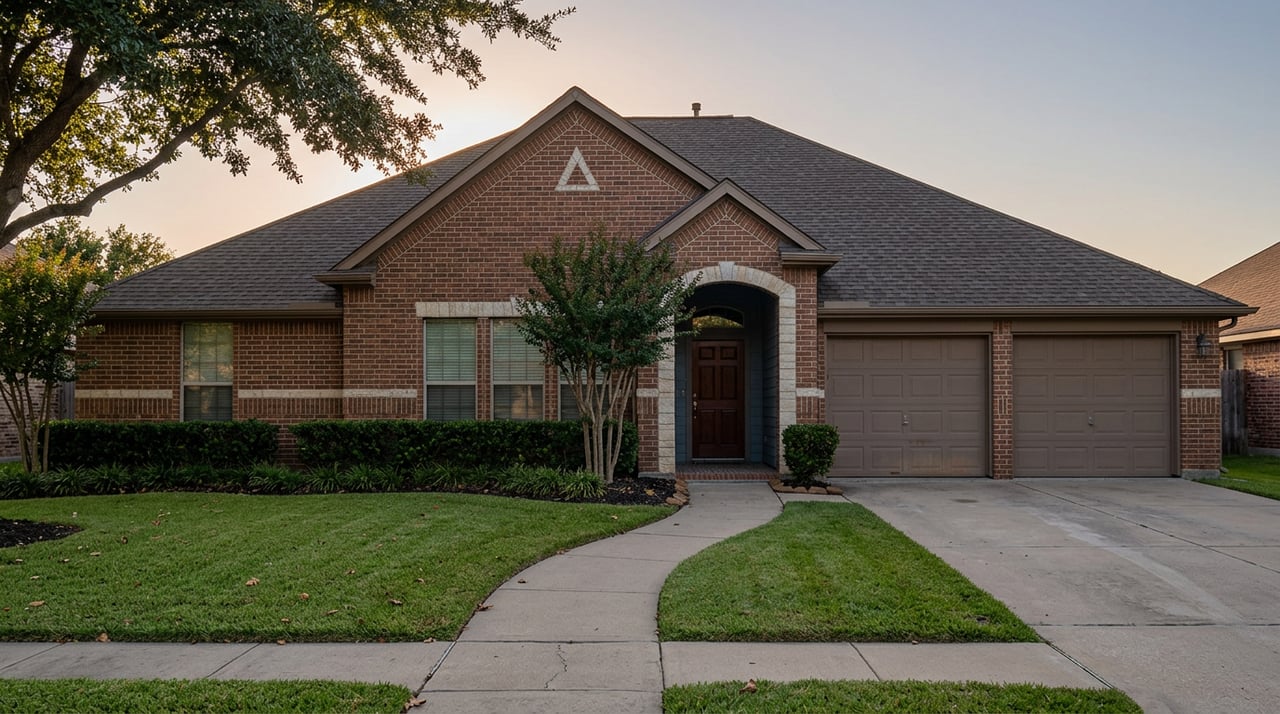
Say you're comparing two four-year-old homes in Magnolia. Same square footage, same price range, maybe even the same builder. One has a monthly city water bill. The other has a septic tank in the backyard and a private well feeding the kitchen sink.
Ask an agent why, and you'll usually hear something about lot size or builder preference. That's not wrong, but it's not the real answer either. The real answer is a calendar. For three years, the City of Magnolia physically could not connect a new house to its water system, no matter how good the lot or how big the builder. Whether your house landed on one side of that freeze or the other still shows up on your closing statement today.
The Freeze That Explains It
On December 21, 2022, Magnolia's city council enacted Ordinance O-2022-031, a temporary building moratorium covering the city limits and its extraterritorial jurisdiction. The reason was blunt: the city's water plants were approaching the capacity thresholds the Texas Commission on Environmental Quality allows for the number of connections a system can serve, and there was no more room to commit to new development without risking service to the households already on the grid.
The city was already under Stage 2 drought restrictions that had gone into effect that October, and staff framed the moratorium as the difference between managing growth on the city's own terms or having an already stressed system fail on its own. The council chose the first option. New water and sewer taps stopped. The moratorium got renewed in 120-day increments six separate times, through August 2025, before the city let it expire on December 14, 2025.
That's nearly three full years where a lot inside Magnolia's jurisdiction could not get a new city water or sewer connection, period.
What Developers Did Instead
A moratorium doesn't stop demand. It redirects it. Builders who wanted to keep closing houses in Magnolia during the freeze had three real options, and you can still see the fingerprints of each one in today's listings:
- Build on a lot large enough for a private well and septic system, since Montgomery County's environmental health rules call for at least 1.5 acres when both are present, versus 0.75 acre if there's no well at all
- Locate inside a Municipal Utility District that had its own water and sewer capacity independent of the city's stressed system
- Tap into a stopgap: the Magnolia Economic Development Corporation put nearly a million dollars into a temporary water system to keep projects like Magnolia Place and Magnolia Village moving on the city's east side while permanent wells were still being drilled
Meanwhile, the city itself was racing to add capacity. Well No. 7 at the Guillemont plant was projected to deliver about 1,600 gallons per minute once it cleared TCEQ approval, enough for roughly 2,660 new connections. Well No. 8, an addition to the Kelly plant, went out to bid and was awarded to Weisinger, Inc. By mid-2025, city engineering staff said Magnolia had grown from three operational wells to five, with two more nearing completion, aiming for combined capacity north of 5,500 gallons per minute, enough to eventually support about 9,200 customers.
The Line Runs Through Individual Lots, Not Just Subdivisions
Here's the part that surprises buyers most: the moratorium didn't sort neatly by neighborhood. It sorted by permit date.
The ordinance exempted any project that already held a valid city permit as of December 16, 2022. Everything filed after that date was locked out of new water and sewer service until the freeze lifted. That means a subdivision built in phases can have Phase 1 houses on full city service and Phase 3 houses on well and septic, sitting on the same street, built by the same company, sold under the same community name.
If you're comparing two Magnolia listings and the utility setup looks inconsistent for no obvious reason, this is almost certainly why. It's not a red flag about the builder. It's a fossil of a policy window.
What This Actually Costs You
The utility difference isn't cosmetic. It changes what you're signing up to pay every year you own the house.
| Cost category | City water and sewer | Private well and septic | MUD service |
|---|---|---|---|
| Recurring bill | Flat monthly city utility bill | No monthly bill, but periodic maintenance | Monthly usage bill plus MUD tax on top of city, county, and school taxes |
| Routine maintenance | None beyond the bill | Septic pump-out every 3 to 5 years, roughly $235 to $485 per pump | Handled by the district |
| Inspection at sale | Rarely required | Required by FHA and VA loans even though Texas has no statewide mandate, typically $300 to $600 | District's Notice to Purchaser disclosure required before closing |
| Special systems | N/A | Aerobic treatment units, common in Montgomery County's clay soils, require a signed maintenance contract with inspections every four months | Bond obligations vary by district and should be requested in writing |
A well and septic system isn't inherently a downgrade. Plenty of buyers prefer the independence and the absence of a monthly water bill. But it is a different cost structure than a flat city utility charge, and a MUD-served home carries a tax line that a straight city-service home doesn't. Two houses priced identically on the listing sheet are not automatically priced identically once you run the ownership math over five years.
The Verification Checklist Before You Write an Offer
None of this requires a specialist. It requires asking for paper before the option period runs out.
- Ask the seller for the recorded septic permit or OSSF number, plus pumping and maintenance receipts, not just a verbal "it's fine"
- If the system is aerobic, confirm the maintenance contract is current and hasn't lapsed
- If the property is in a MUD, request the Notice to Purchaser and the current bond and tax rate in writing before closing
- Confirm when the water tap was actually granted relative to December 16, 2022, if you're trying to understand why a lot ended up on one system versus another
- If you're financing with FHA or VA, budget for the lender-required septic evaluation early. It's a mortgage condition, not a TCEQ requirement, so it can catch buyers off guard late in the process
The Moratorium Is Over, But the Caution Isn't
Lifting the freeze on December 14, 2025 didn't erase the pressure that caused it. Magnolia's population grew by an estimated 147 percent between 2020 and 2024, and city officials have said publicly they expect it to double again within five years. The $1 billion, 200-acre Magnolia Town Center proposal near Highway 249 and FM 1488, still working through the city's planning and engineering review, is the clearest sign that development interest didn't slow down while the taps were shut off. It just waited.
City leadership has been explicit that new connections will be managed more carefully this time, tied to actual well output rather than optimistic projections. That's a reasonable response to what happened the first time. For a buyer, it means the well-versus-city-water question isn't fully settled just because the ordinance expired. New construction breaking ground today is being permitted under a system still calibrating its own limits, and the next round of capacity math could shape which lots get city taps and which don't, the same way the last one did.
A Few Questions Worth Asking Directly
Does every home outside Magnolia's city limits use well and septic? No. Many properties in the unincorporated county and in the city's ETJ are served by a Municipal Utility District instead. Well and septic tends to show up on larger acreage tracts where county lot-size rules require it or where no utility provider was ever extended to the parcel.
Is a septic system a sign something is wrong with the house? Not on its own. It's a maintenance system with its own schedule, not a defect. The questions worth asking are about age, permit status, and whether maintenance records exist, the same way you'd ask about a roof or an HVAC system.
Will MUD taxes go up over time? MUD rates vary by district and are tied to the bonds the district issued to build its infrastructure. Ask for the current rate and bond schedule in writing rather than assuming it mirrors a neighboring district.
If you're weighing two Magnolia properties and the utility setup doesn't add up on paper, that's exactly the kind of detail worth working through before you're locked into an option period. Kim Kindred has spent years tracking how Montgomery County's growth decisions play out lot by lot. Schedule your free consultation and get a straight read on what a specific address is actually connected to, and what that means for your budget five years out.