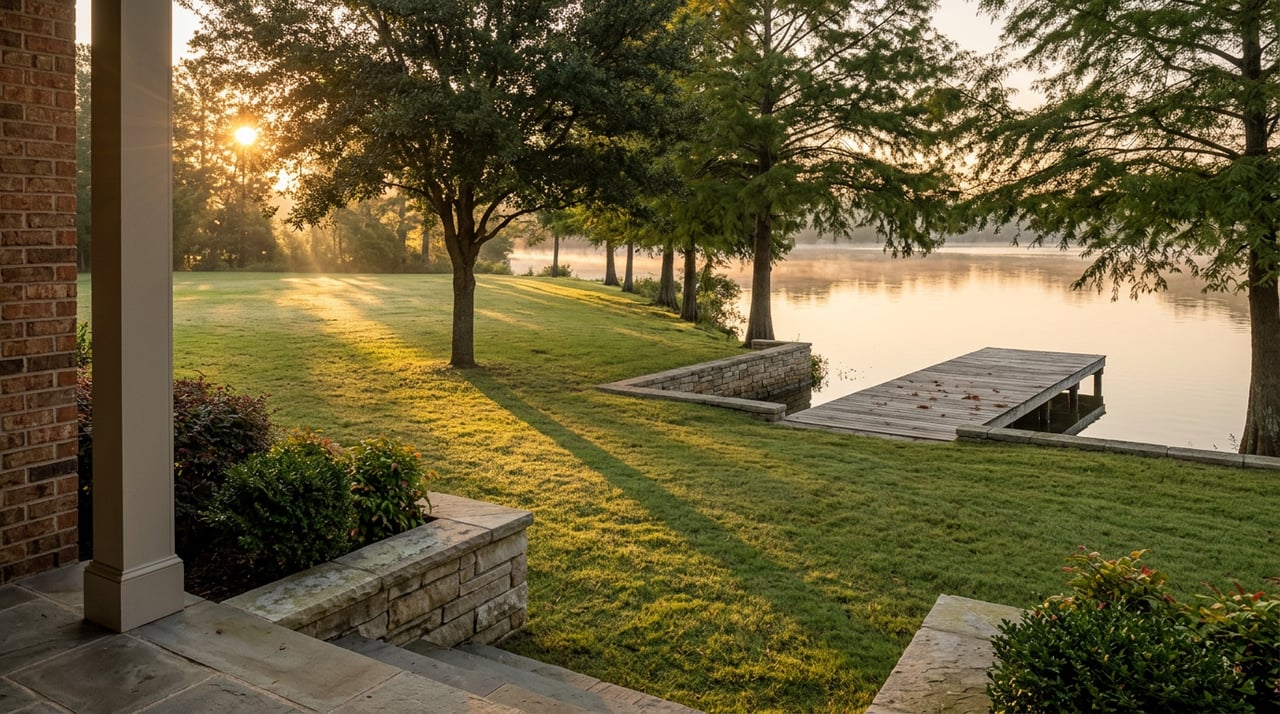
You find the listing. Waterfront, private dock, boat lift, a photo of the sunset over open water. The price feels like it accounts for all of it, the way a pool or a finished basement gets baked into what you're paying. It doesn't. The dock, the lift, and often the bulkhead holding your yard in place are not deeded parts of the property in the way most buyers assume. They're licensed structures sitting on a reservoir the San Jacinto River Authority controls, and the agency that grants that license is explicit that it can take it back.
That distinction matters more on Lake Conroe than almost anywhere else in Montgomery County real estate, because it changes what you're actually comparing when you shop "waterfront." Two homes can look like the same product at different price points. They're often two different products entirely, and the difference lives in paperwork most buyers never ask to see before they write an offer.
The Median You're Reading Isn't One Market
As of July 2026, the median home price across the broader Lake Conroe area sat at $349,886, with an average sale price of $426,980. That single number gets treated like a benchmark for waterfront living. It isn't. The Lake Conroe geomarket that generates that median includes a large share of homes that sit near the lake, in golf communities or gated subdivisions, without ever touching the water. It also includes true open-water and canal-front properties governed by an entirely separate set of rules.
You can see the split more clearly at the community level. Walden, the lake's largest resort community, prices interior homes from around $350,000 while its true waterfront and golf-course lots run $700,000 to $1.5 million and up. April Sound, the gated peninsula community with its own country club, spans roughly $300,000 for established inland homes to $800,000 or more for direct lakefront. Grand Harbor, a smaller custom-home enclave, has recently shown a median appraised value near $759,000. The Estates of Lake Conroe, a boutique community of custom builds, starts waterfront pricing near $700,000. Four communities, four very different price floors, all technically inside "the Lake Conroe area."
Ask how long these homes typically sit on the market this year and you'll get answers that don't agree with each other. One public listing feed puts average days on market at 153 for the broader Lake Conroe geomarket as of July 2026. A separate market update for the same geographic area shows 66.1 days. That gap isn't a data error so much as a symptom. Blend a fast-moving inland resale market with a thin, slow-moving true-waterfront segment and you get numbers that contradict each other depending on which slice of inventory dominates the sample that month. If you're shopping "the median," you're shopping an average of two different buying experiences.
Grand Central Park Isn't a Lake Conroe Answer
One more wrinkle catches buyers searching broadly for "lake community near Conroe." Grand Central Park, the 2,046-acre master-planned community developed by Johnson Development just north of The Woodlands, markets access to six lakes and a resort-style amenity complex called The Lake House. It's a genuinely appealing community with trails, a marketplace anchored by Kroger and Dick's Sporting Goods, and homes from the low $330,000s. None of those six lakes is Lake Conroe. They're community amenity lakes, built for the neighborhood, not the reservoir the San Jacinto River Authority regulates a few miles away. If deeded lake access, a private dock, or SJRA-permitted structures are part of what you're shopping for, Grand Central Park solves a different set of priorities than the one you're picturing.
What the Dock Actually Is
The San Jacinto River Authority's Lake Conroe Division licenses every private dock, boat lift, and bulkhead on the reservoir. Its own residential structure guidance states plainly that the right to build, keep, or maintain one of these structures is not an inherent right that comes with owning waterfront property. No structure can be built, operated, or maintained without a permit, and that permit can be revoked at any time. An annual fee applies to each licensed structure, based on its size and location, and the agency is under no obligation to hold the reservoir at a level convenient for a private dock's continued use.
That last part is worth sitting with. You are not just buying a house with a dock attached. You are buying a house, and separately, a renewable license to keep a private structure on public reservoir land, subject to a regulator that owes you no particular water level and can pull the permit for cause. Whether that license transfers cleanly to a new owner at closing is a question worth asking directly, in writing, before your option period runs out.
HOA architectural review boards add another layer on top. In gated communities like Walden, April Sound, and Bentwater, design rules for a new dock or bulkhead replacement can be stricter than anything SJRA requires on its own. Ask for current guidelines, not a copy from a few years back, before assuming a proposed project sails through.
Why the Calendar Matters for an Inspection
Lake Conroe's normal pool sits at 201 feet above mean sea level. Since Hurricane Harvey, when the reservoir reached its historic high of 206.24 feet in August 2017, the San Jacinto River Authority has operated under what it calls Active Storm Management. Under that policy, the City of Houston, which owns two-thirds of the reservoir's water, can request the lake be drawn down to as low as 200.5 feet, and in some cases lower, between April 1 and June 1 each year to create storage capacity ahead of forecast rain.
That seasonal drawdown is a small window, but it's the one time of year a bulkhead's true condition and a dock's actual clearance are easiest to see. Shop a listing in late spring and a lower lake can expose problems, or reveal a structure in better shape than the listing photos suggested. As of August 26, 2026, the reservoir sat at 95.8 percent full, well above the storm-management thresholds and typical of where the lake tends to hold through a calm summer. If you're touring a waterfront home outside that spring window, ask when the dock and bulkhead were last inspected at a lower pool level, because you likely won't get to see it that way yourself before closing.
What the Second Asset Actually Costs
Buyers who treat the dock as a free amenity are usually underestimating what it costs to keep. A new private dock typically runs into the low tens of thousands of dollars for a modest build, more for a covered slip or custom design. A boat lift replacement can range from the mid-thousands to low tens of thousands depending on capacity. Bulkhead work varies the most. Short repair sections may run in the low tens of thousands, while a full engineered bulkhead replacement on a longer run can reach $50,000 to $150,000 or more, largely dependent on materials and how much of the shoreline needs stabilizing. Freshwater is gentler on these structures than saltwater, but Lake Conroe's water-level swings and storm exposure still take a toll over time.
A Short Pre-Offer Checklist
- Confirm the SJRA permit on any existing dock, lift, or bulkhead is current, and ask in writing whether it transfers to a new owner or requires reapplication.
- Ask for maintenance records and recent photos of the dock and bulkhead, ideally taken during a lower-water period.
- Check whether the community, not just SJRA, has architectural review rules that would apply to future repairs.
- If you're considering short-term rental income near Del Lago or Margaritaville Lake Resort, verify the specific subdivision's covenants directly. Individual HOAs set their own rules, and they don't all allow it.
- Ask whether the property sits on open water or a protected canal, like those in Cape Conroe. Canal lots trade some wave exposure for shallower water and tighter maneuvering, which matters if you're shopping for a larger boat.
A Few Questions Worth Asking Directly
Does a canal lot on Lake Conroe count as real waterfront? Legally, yes, SJRA regulates canal frontage the same way it regulates open water. Practically, canal lots offer more shelter from wind and wake, but often have shallower depth and less room to maneuver a larger boat.
If I buy a home with an existing dock, do I need to reapply for the permit? Not always, but you should never assume otherwise. Rules and fees can change, and SJRA may require a renewal or acknowledgment when ownership changes hands. Confirm this before your option period ends, not after.
Is the Lake Conroe median price a reliable way to compare listings? Only if you know which side of the market a given listing sits on. A blended geomarket median mixes inland homes near the lake with true waterfront and canal-front properties carrying dock, lift, and bulkhead permits. Compare like to like, not median to median.
If you're weighing a move onto Lake Conroe, or trying to figure out which community actually matches what you pictured when you searched for it, a conversation up front can save you weeks of confusion later. Kim Kindred has spent years walking Montgomery County buyers through exactly this kind of due diligence, from permit transfers to HOA architectural review, before an offer ever gets written. Schedule your free consultation and let's figure out which Lake Conroe you're actually shopping for.